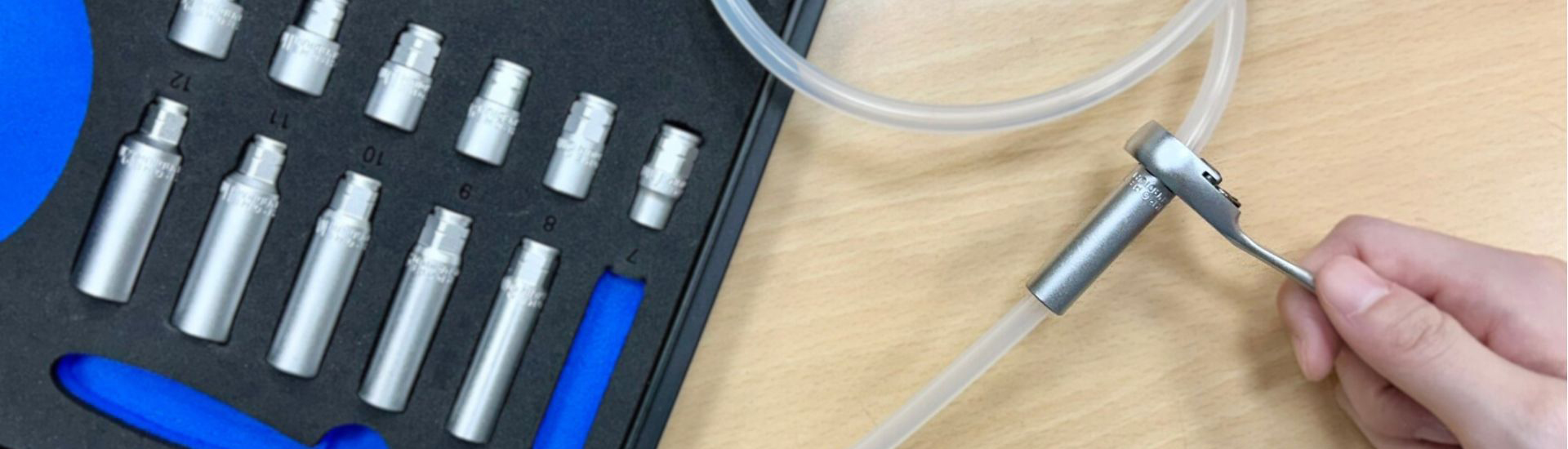
In modern automotive, industrial, and machinery maintenance, space is getting tighter while components are getting more complex. Traditional sockets and ratchets don’t always fit, especially around engines, suspension systems, and inside compact machines. That’s where the super short socket—also commonly called a low profile socket—comes in.
Companies like ACT Quality Industrial Co., Ltd. (ACT TOOLS) specialize in developing super short socket solutions that work perfectly with their modular Insert-Snap wrench systems, giving technicians more access and control in tight spaces.
This article explains what a super short (low profile) socket is, how it’s designed, and when it makes a real difference in your daily work.
What Is a Super Short Socket (Low Profile Socket)?
A super short socket (or low profile socket) is a socket specifically designed with a much shorter body length compared to a standard socket, while keeping the same drive size (1/4", 3/8", 1/2") and hex size (e.g. 10 mm, 12 mm, 17 mm, etc.).
In other words:
- The top and bottom interfaces are the same as a regular socket:
- Square drive at the back
- Hex / 12-point / Torx / E-socket shape at the front
- The overall height is reduced, sometimes dramatically
- When combined with a compact ratchet or an insert-type wrench system, the total tool length becomes very short and easy to maneuver in confined areas
Because of this low profile, these sockets are ideal for applications where every millimeter of clearance counts.
Key Design Features of Super Short (Low Profile) Sockets
While the exact design can vary between brands and series, most super short sockets share a few important characteristics:
1. Ultra-Compact Body Length
The most obvious feature is the reduced height:
- Less vertical space needed above the fastener
- The socket + drive tool combination is shorter than a normal socket setup
- Helps avoid interference with surrounding parts, brackets, hoses, or body panels
2. Standard Drive and Fastener Interface
Despite being shorter, a super short socket still offers:
- Standard square drive sizes: 1/4", 3/8", 1/2"
- Common fastener profiles:
- Hex (6-point or 12-point)
- Torx / TX-Star
- E-Sockets (External Torx)
- Occasionally special profiles like Ribe or Spline in some sets
This means you can use low profile sockets with your existing ratchets, insert-snap wrenches, and extension bars, as long as the drive size matches.
3. High-Strength Materials
Because shorter sockets have less body length, they must still handle torque safely. Most quality super short sockets are made from:
- Chrome Vanadium (CR-V) steel for strength and durability
- S2 steel bits when combined as bit sockets
- Heat treatment and surface finishing (e.g. chrome plating, phosphate coating) for corrosion resistance and long service life
4. Optimized Geometry for Access
Low profile sockets are usually paired with:
- Compact ratchets or insert-style wrenches
- Wobble extensions or universal joints for angle access
- Deep or standard sockets in the same set to cover different access scenarios
This combination allows you to approach the fastener straight on or at a slight angle while still keeping a very low tool height.
When Should You Use a Super Short / Low Profile Socket?
You can think of super short sockets as a problem-solver when standard sockets are “too long” or constantly hitting something. Here are common situations where they shine.
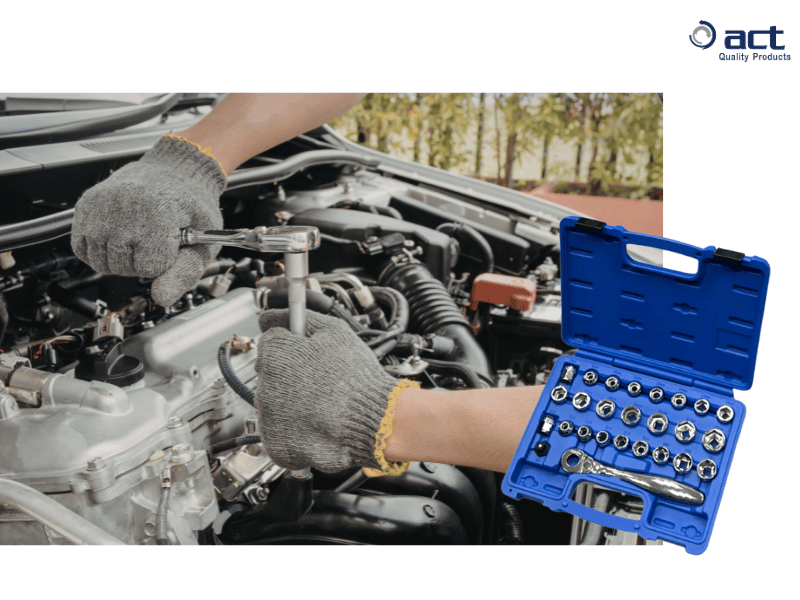
1. Tight Automotive Engine Bays
Modern engines are packed with:
- Turbochargers
- Emission control components
- Wiring harnesses
- Heat shields and covers
When working on components like:
- Intake manifolds
- Valve covers
- Engine mounts
- Auxiliary brackets
You often don’t have room for a standard socket plus a big ratchet head. A low profile socket with a compact wrench lets you:
- Reach fasteners between hoses and pipes
- Turn bolts close to the firewall or strut tower
- Work around tight corners without removing extra parts
2. Suspension and Chassis Areas
Under the vehicle, you’ll find:
- Control arms
- Anti-roll bars
- Subframes
- Brake and fuel lines
Access can be blocked by structural members or nearby components. A super short socket can help in:
- Loosening fasteners on suspension arms in tight corners
- Working around shock mounts and top hats
- Adjusting brackets that sit close to the frame
3. Interior and Dashboard Work
Inside the cabin and behind the dash, space is even more limited:
- Instrument panel brackets
- HVAC units
- Seat rails and mounting points
- Center console and steering column hardware
A low profile socket combined with a short handle or insert-snap wrench lets you:
- Reach fasteners behind panels without removing half the interior
- Loosen bolts near the windshield base or steering column
- Work in awkward angles with minimal swing room
4. Industrial Machinery and Equipment
In industrial environments, enclosures and machine frames often leave little space around fasteners. Super short sockets are useful for:
- Maintenance inside equipment housings
- Tight motor mounts and gearbox flanges
- Machinery where guards or frames limit tool access
They reduce the need to partially disassemble guards just to get a socket on a bolt.
5. When You Want a More Compact Professional Tool Kit
For technicians who travel or work in multiple locations, space in the toolbox is also a real constraint. A well-chosen set of super short (low profile) sockets can:
- Cover a wide range of metric or SAE sizes
- Take up less room in the case
- Work with modular systems (e.g., insert-snap wrenches, adaptors, bit sockets)
Instead of carrying many bulky tools, you can build a compact, high-efficiency kit that still handles most daily tasks.
Super Short Socket vs. Standard Socket: What’s the Trade-Off?
In practice, professional users don’t replace regular sockets completely—they add low profile sockets to their kit as a complement, especially for difficult access jobs.
Super Short / Low Profile Socket – Advantages:
- Excellent for tight spaces
- Reduces overall tool length
- Works well with compact wrench systems
- Ideal for modern vehicles and compact machinery
Standard Socket – Advantages:
- More leverage when used with long ratchets
- Often more comfortable for high-torque work
- Very common and usually cheaper per piece
The most efficient workflow is having both, and choosing the right one based on access and torque requirements.
How ACT TOOLS Integrates Super Short (Low Profile) Sockets
As a professional hand tool manufacturer in Taiwan, ACT Quality Industrial Co., Ltd. (ACT TOOLS) designs super short socket sets to work seamlessly with its signature Insert-Snap wrench system. By combining:
- Super short sockets
- Insert-Snap wrenches (11H, 17H, 22H, etc.)
- Wobble extensions, universal joints, and bit adaptors
ACT TOOLS helps technicians build modular, compact tool systems that:
- Improve access in cramped spaces
- Reduce the number of separate tools needed
- Maintain high torque capacity and durability
For workshops looking to upgrade their toolkit for modern vehicle and machinery designs, low profile socket sets from ACT TOOLS offer a practical, professional solution.
Planning to run super short sockets on a power tool? Make sure you choose impact-rated versions. Our guide Impact Socket vs Chrome Socket: Differences, Materials, and How to Choose explains how chrome and impact sockets differ in steel, wall thickness and safety.
Conclusion: A Small Tool That Solves Big Access Problems
A super short socket is specifically designed to solve one of the most common challenges in mechanical work—limited space. Compared to standard or even shallow sockets, its ultra-low profile allows technicians to access fasteners in confined areas where conventional tools simply cannot fit. This makes it especially valuable in automotive repair, machinery maintenance, and precision assembly tasks.
By combining a compact design with compatibility for ratchets, extensions, and torque tools, super short sockets provide both accessibility and efficiency without sacrificing usability. Choosing the right socket length based on the working environment is essential, as different applications require different levels of clearance and reach. Ultra-short solutions are ideal when every millimeter of space matters.
As a professional super short socket manufacturer, ACT Quality Industrial Co., Ltd. (ACT TOOLS) focuses on developing compact, high-performance socket solutions for modern maintenance challenges. With precision manufacturing, durable materials, and optimized low-profile designs, our tools are engineered to help technicians work more efficiently in tight and complex environments.