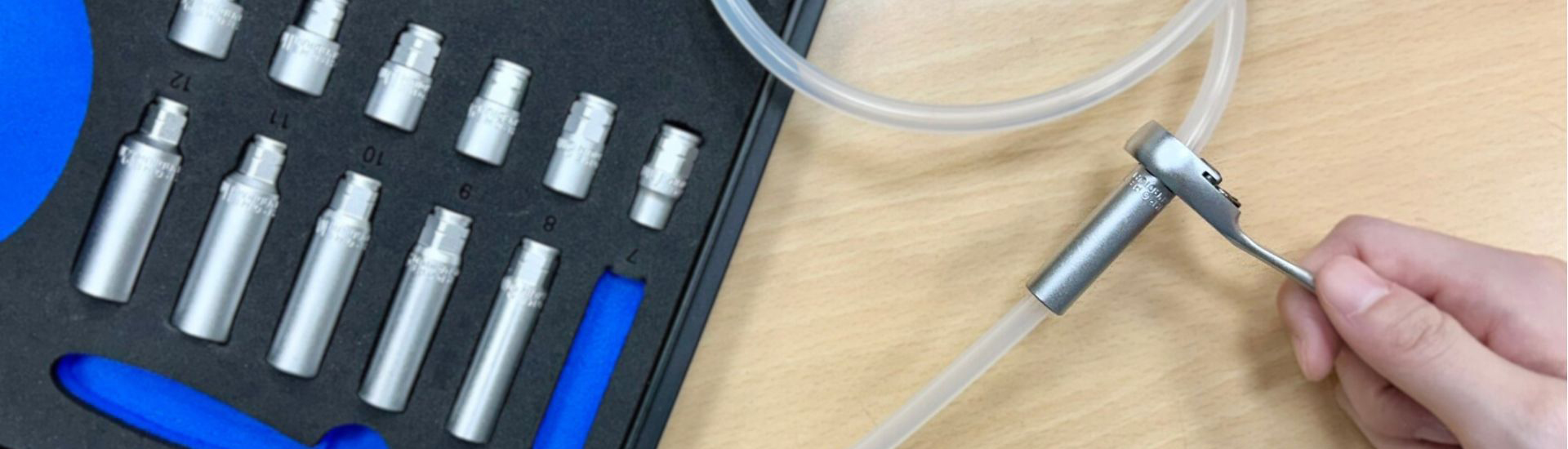
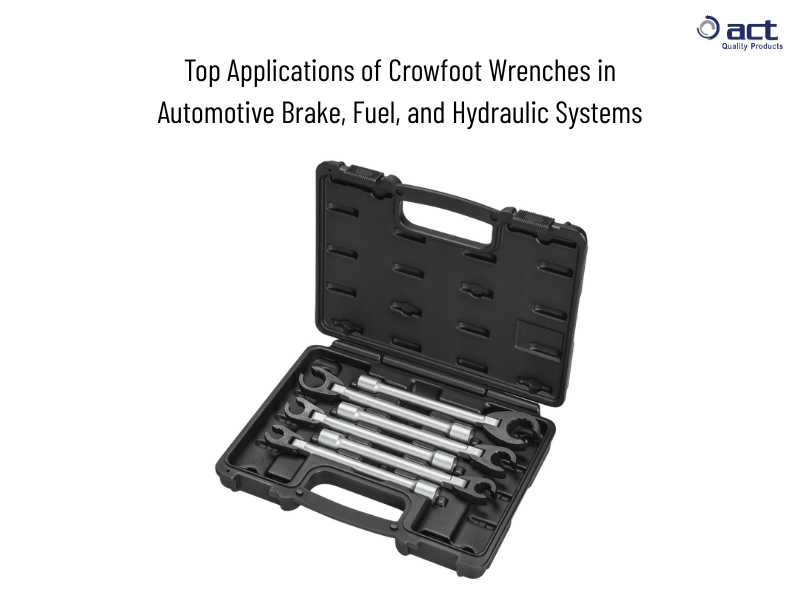
In our last article, we introduced what a crowfoot wrench is and how it works. This time, we want to go one step further and focus on the part that matters most in real service work: application. At ACT Quality Industrial Co., Ltd. (ACT TOOLS), we develop tools for technicians who deal with tight access, limited swing room, and torque-critical fasteners every day.
A crowfoot wrench is especially useful when a standard socket cannot fit over a line fitting or when a normal wrench cannot rotate because surrounding parts block the handle. Because it connects to a ratchet, extension bar, or torque wrench through a square drive, it gives technicians a way to reach fittings in narrow, obstructed areas while still maintaining controlled fastening.
1. Brake Line Service Around the Master Cylinder and ABS Module
One of the most common applications for a crowfoot wrench is brake line service. Modern brake systems often place hard line fittings in cramped areas around the master cylinder, ABS module, or firewall. In these positions, a regular open-end wrench may have very little room to turn, while a standard socket usually cannot be used at all because the brake line passes through the center of the fitting.
This is where a crowfoot wrench becomes especially practical. By attaching the crowfoot head to an extension bar or torque wrench, the technician can approach the fitting from a better angle and apply torque with more control. For brake work, this matters not only for convenience, but also for safety. Incorrect tightening can lead to leaks, thread damage, or unreliable hydraulic performance.
In these situations, many technicians prefer a flare nut style crowfoot, since it grips more of the fitting than a simple open-end design. That extra contact helps reduce the risk of rounding softer or corrosion-prone nuts during service.
2. Fuel Line Connections in Tight Engine Bays
Fuel systems are another area where crowfoot wrenches are highly effective. In modern engine compartments, line fittings are often surrounded by covers, brackets, hoses, and wiring harnesses. Even when a fastener is visible, it may still be difficult to reach with a normal wrench because there is not enough room for handle movement.
A crowfoot wrench helps solve this problem by moving the driving force away from the fitting itself. Instead of forcing your hand into the tightest part of the engine bay, you can attach the crowfoot to a ratchet or extension and work from a more accessible position. This improves control and reduces the chance of slipping into surrounding components.
For fuel system service, controlled tightening is also important. Over-tightening can damage fittings, while under-tightening can lead to leaks. That is why compatibility with a torque wrench is one of the key advantages of crowfoot designs in automotive repair.
3. Hydraulic Clutch and Pressure Line Applications
Crowfoot wrenches are also widely used on hydraulic clutch lines and other pressure-line connections. These systems often share the same challenge as brake lines: the fitting is easy to identify but difficult to reach with a standard tool. The line itself prevents socket use, and surrounding components restrict the travel of a conventional wrench.
Using a crowfoot wrench allows the technician to work around the line rather than against it. This is especially helpful when replacing slave cylinders, servicing clutch master cylinders, or working on compact hydraulic circuits where both sealing integrity and torque accuracy matter. In these cases, a crowfoot wrench is not just a convenience tool; it becomes a practical way to reduce rework and avoid damaged fittings.
4. A/C and Other Fluid Line Fittings
Although brake and fuel systems are the most obvious examples, crowfoot wrenches are also valuable in A/C line service and other automotive fluid systems. These fittings are often tucked behind compressor assemblies, under engine covers, or along chassis rails where normal tool access is restricted.
In these positions, a crowfoot wrench gives the technician a slim working head with external drive capability. That combination makes it easier to service fittings without removing extra nearby parts just to gain hand clearance. Over time, that can save significant labor in both workshop and field-service environments.
5. Hydraulic Manifolds and Industrial Maintenance
Although many users first associate crowfoot wrenches with automotive work, the application range extends well beyond vehicles. In industrial maintenance, technicians frequently work on hydraulic manifolds, piping systems, valve blocks, and machine frames where fittings are mounted close to walls, guards, or structural members.
In these applications, the ability to connect the crowfoot head to an extension or torque wrench is a major advantage. It lets maintenance personnel reach line fittings inside crowded assemblies and apply controlled torque without disassembling large surrounding structures. This is particularly valuable when maintenance time is limited and minimizing downtime is critical.
6. Why Torque Control Matters in These Applications
Across all of these applications—brake, fuel, hydraulic clutch, A/C, and industrial fluid systems—the common issue is not just access. It is access plus torque control. Many of these fittings are safety-related, pressure-related, or leak-sensitive. A tool that reaches the fitting but does not allow stable torque application is only half a solution.
This is why we place such strong emphasis on product verification. On our website, ACT TOOLS publishes multiple test reports, including Torque Capability Test – Flexible Crowfoot Wrench documents. That gives customers and distributors direct access to documented test data rather than relying on claims alone.
How ACT TOOLS Approaches Crowfoot Wrench Applications
At ACT Quality Industrial Co., Ltd., we have been developing professional hand tools since 1996, and our product direction has continued to focus on compact design, high torque, and multifunctional integration. That philosophy fits crowfoot wrench applications perfectly, because these tools are all about solving real access and fastening problems in the field.
For workshops and maintenance teams, crowfoot wrenches work especially well as part of a complete system. They can be paired with ratchets, torque wrenches, extension bars, and other compact ACT tool solutions to create a more flexible toolkit for tight-space repair. When technicians frequently move between brake service, fuel system work, and hydraulic maintenance, that modularity becomes a real productivity advantage.
Conclusion
Crowfoot wrenches are most valuable when the job involves line fittings, limited access, and controlled torque. That is why they are so widely used in automotive brake systems, fuel line connections, hydraulic clutch circuits, A/C service points, and industrial hydraulic maintenance. In all of these applications, the tool helps technicians reach what standard tools cannot and tighten what standard sockets cannot accommodate.
As a professional crowfoot wrench manufacturer, ACT Quality Industrial Co., Ltd. (ACT TOOLS) understands that these tools are not just accessories, but essential problem-solving solutions in real-world service environments. By combining compact design, torque-wrench compatibility, and verified torque performance, our crowfoot wrench solutions are developed to meet the demands of modern automotive and industrial maintenance.