In many real-world repair and maintenance jobs, the biggest challenge is not the torque you need, but the space you don’t have. Around engines, hydraulic lines, brake systems, and industrial piping, there are bolts and flare nuts that a normal wrench or socket simply cannot reach.
This is exactly the kind of problem a Crowfoot Wrench is designed to solve.
At ACT Quality Industrial Co., Ltd. (ACT TOOLS), we focus on hand tools that make tight-space work safer, faster, and more precise. Our flexible crowfoot wrenches are engineered for technicians who need reliable torque and access in places where conventional tools fail.
What Is a Crowfoot Wrench?
A Crowfoot Wrench is essentially a wrench head without a handle. Instead of having a built-in handle like a traditional open-end wrench, it has:
- An open-end or flare-nut style jaw at the front for gripping the fastener
- A square-drive opening at the back, designed to connect to:
- Ratchets
- Torque wrenches
- Extension bars
In simple terms, you can think of a crowfoot wrench as a detachable wrench head that turns your ratchet or torque wrench into an open-end wrench for hard-to-reach fasteners.
Why Use a Crowfoot Wrench Instead of a Regular Wrench?
A standard combination wrench works in many situations, but a crowfoot wrench offers several advantages in tight or obstructed spaces.
1. Access in Confined Areas
Because there is no built-in handle, the crowfoot head can be positioned at the end of an extension bar. This allows you to:
- Reach fasteners that are recessed or surrounded by pipes, brackets, or hoses
- Work around obstacles where a regular wrench cannot swing
- Operate from a distance while the crowfoot head sits in a tight cluster of components
2. Compatible with Torque Wrenches
One major advantage is the ability to use a crowfoot wrench with a torque wrench. Many critical fittings—such as brake lines, fuel lines, ABS components, or hydraulic connections—must be tightened to a specific torque. A crowfoot wrench allows you to:
- Apply controlled torque on a flare nut or hex nut in a tight spot
- Meet OEM torque specifications even when the fastener is not directly accessible with a standard socket
3. Flexible Angles and Positions
Crowfoot wrenches can often be used in different orientations on the square drive, giving you flexibility in how the head is positioned relative to the handle. Combined with extensions and universal joints, this creates multiple ways to approach the same fastener.
Common Types of Crowfoot Wrenches
Depending on the specific job, different crowfoot designs are used:
- Open-end crowfoot: For general hex-fastener applications.
- Flare nut crowfoot: For brake, fuel, A/C, and hydraulic line fittings where more contact around the nut is needed.
- Drive sizes: Typically 3/8" or 1/2" drive, matching standard ratchets and torque wrenches.
- Metric and SAE sizes: To cover both automotive and industrial standards in different markets.
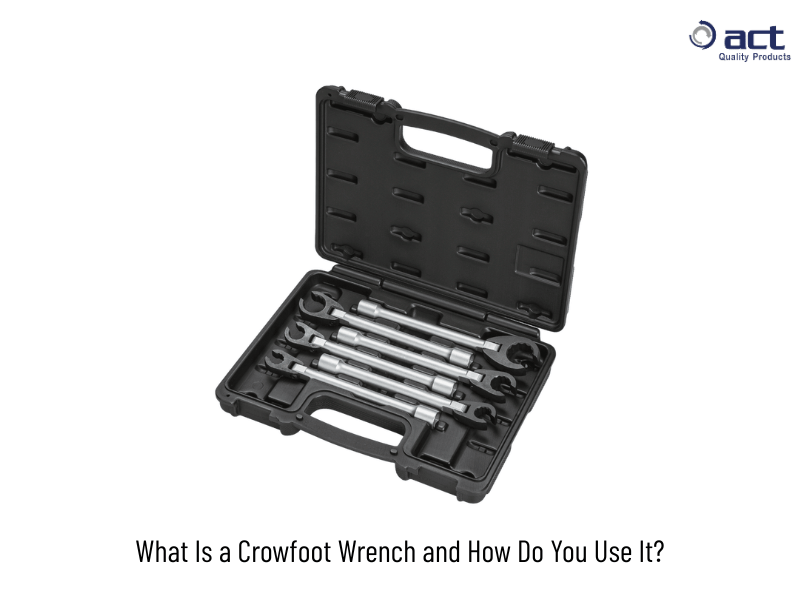
As a manufacturer, we design our crowfoot wrenches to cover the most commonly used sizes in professional workshops, so technicians can quickly select the right tool from a compact, organized set.
Where Is a Crowfoot Wrench Most Useful?
1. Automotive Brake and Fuel Systems
This is one of the most common applications. Crowfoot wrenches are ideal for:
- Brake line fittings on master cylinders or ABS modules
- Fuel line connections near the engine or under the vehicle
- Hydraulic clutch lines and other pressure fittings
Using a flare nut crowfoot with a torque wrench helps prevent leaks and damage by tightening fittings to the correct value.
2. Engine and Powertrain Work
Modern engine bays are extremely compact. Crowfoot wrenches are used to:
- Access bolts and nuts hidden behind brackets or intake components
- Reach fasteners near the firewall, strut towers, or close to engine mounts
- Handle fasteners where a normal socket would be blocked by surrounding parts
3. Industrial and Hydraulic Systems
In industrial environments, piping systems, hydraulic manifolds, and valve blocks often leave very limited room to work. A crowfoot wrench allows maintenance technicians to:
- Tighten or loosen fittings inside crowded manifolds
- Work on piping close to walls or frames
- Apply torque without needing to remove large sections of piping or guarding
4. Tight Access on Equipment and Machinery
Anywhere a fastener is close to a housing, frame, or panel, a crowfoot wrench can be the difference between "impossible" and "done in minutes". This includes maintenance on:
- Construction equipment
- Agricultural machinery
- Material handling machines and forklifts
How to Use a Crowfoot Wrench Correctly
Using a crowfoot wrench is generally straightforward, but there are some best practices:
- Select the correct size for the nut or fitting to ensure full contact and prevent rounding.
- Attach it to the ratchet or torque wrench using the correct drive size (3/8" or 1/2").
- Use an extension bar if needed to reach the fastener comfortably.
- Align the crowfoot head properly on the fastener to maximize surface contact.
- Apply steady force rather than sudden jerks, especially on line fittings and softer materials.
When using a crowfoot with a torque wrench and the crowfoot is at an angle that effectively lengthens the lever arm, you may need to compensate for the torque change depending on the angle and manufacturer recommendations. In many practical workshop situations, keeping the crowfoot at 90° to the torque wrench handle minimizes the error.
FAQ: Crowfoot Wrench Basics
Q1. Can I use a crowfoot wrench with any torque wrench?
Yes, as long as the drive size matches (for example, a 3/8" drive crowfoot with a 3/8" drive torque wrench). For accurate torque, keep the crowfoot at 90° to the torque wrench whenever possible, or follow the torque correction formula recommended by the torque wrench manufacturer.
Q2. What is the difference between a crowfoot wrench and a flare nut wrench?
A flare nut wrench is a traditional hand tool with a fixed handle and a partially closed head designed to grip tubing nuts. A crowfoot wrench is just the head portion, with a square drive instead of a handle, so it can be used with ratchets, torque wrenches, and extension bars in tight spaces.
Q3. When should I choose a flare nut style crowfoot instead of an open-end type?
Use a flare nut crowfoot when working on brake lines, fuel lines, A/C lines, and hydraulic tubing. It grips more of the nut’s surface than a standard open-end design, helping prevent rounding on softer or critical fittings.
Q4. Do crowfoot wrenches replace normal wrenches and sockets?
No. Crowfoot wrenches are a complement, not a complete replacement. They are best used when a regular socket or combination wrench cannot reach or cannot swing properly. Most professionals keep both standard tools and crowfoot sets in their toolbox.
Q5. What kind of users benefit most from crowfoot wrenches?
Crowfoot wrenches are especially useful for automotive technicians, motorcycle mechanics, industrial maintenance engineers, and field service technicians—anyone who frequently works on compact systems with hard-to-reach fasteners.
Torque Capability Test – Flexible Crowfoot Wrench
At ACT Quality Industrial Co., Ltd. (ACT TOOLS), we know that access alone is not enough—torque strength and safety are just as important. That is why we perform dedicated Torque Capability Tests on our flexible crowfoot wrench products.
For our Flexible Crowfoot Wrench series (for example 17 mm, 19 mm, 22 mm 3/8" Dr. models), we conduct controlled torque tests to verify that each size can withstand the specified load with a safe margin. The corresponding test reports are published on our website, so customers and distributors can review real test data and documentation whenever they need additional assurance.
By making these torque test certificates openly available, we demonstrate that our tools are not only convenient in tight spaces, but also engineered and validated for professional torque demands.
Conclusion
A crowfoot wrench is a simple yet highly effective tool for accessing fasteners in tight or obstructed spaces where standard wrenches and sockets cannot be used. By attaching it to a ratchet or torque wrench, users can maintain flexibility, precision, and proper torque control even in the most challenging working environments.
Understanding how to correctly position the crowfoot wrench—especially when working with torque specifications—is essential to ensure accuracy and avoid damage to critical components. When used properly, it becomes an indispensable solution for automotive, hydraulic, and industrial applications.
As a professional crowfoot wrench manufacturer, ACT Quality Industrial Co., Ltd. (ACT TOOLS) is committed to providing high-quality, precision-engineered tools that help technicians work more efficiently in confined spaces. With reliable performance and compatibility with torque tools, our crowfoot wrench solutions are designed to meet the demands of modern maintenance and assembly work.